Eight-year-old Maryam sits on a hospital bed. Her skeletal body is swallowed by a white metal frame, the baby pink T-shirt hanging off her like a rag on a stick.
Her mother Madlala, eyes hollow, scrolls through old photos: Maryam before the war, cheeks plump and laughing, ribbons in her hair. Now, in footage shared with Service95, she lifts her daughter’s shirt to reveal a distended belly and a ribcage so stark it seems drawn on, every bone pressed sharply against skin, like something from an anatomy book.

Madlala hasn’t left Maryam’s side in days, she says: “Her hair is falling out. She has a calcium deficiency. She can’t go to the bathroom by herself and I have to carry her. She starts crying and asks: ‘What’s wrong with me?’... I have no other daughters but her.”
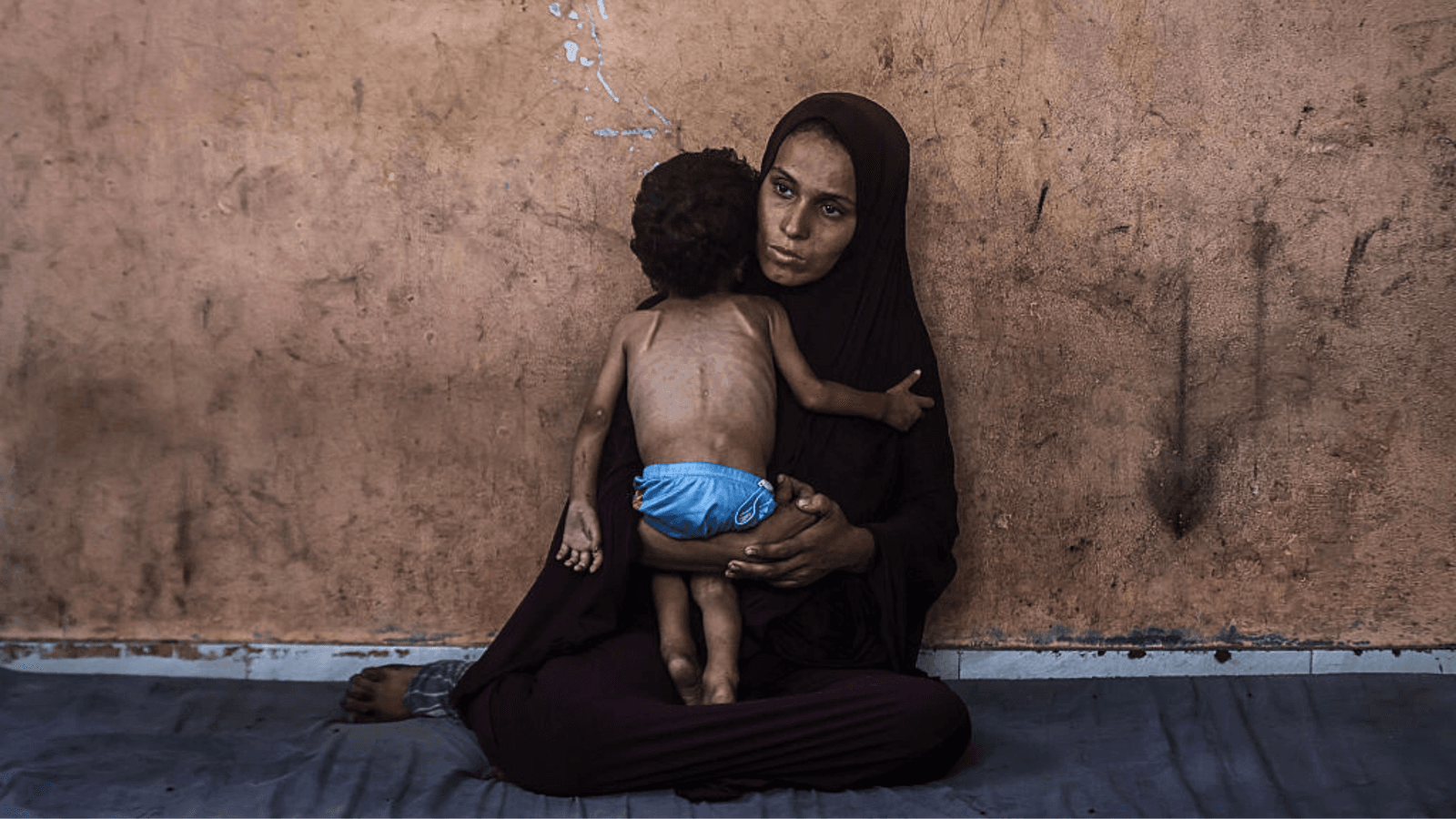
Maryam is one of thousands of children in Gaza teetering on the brink of death by starvation. But it’s not just children. Mothers, too, are wasting away alongside them – skipping meals, fainting from hunger, trying to conjure milk from bodies that have long since stopped producing it.
“I eat one meal a day,” says Lina, a mother of one in a WhatsApp voice note, barely audible over the constant buzz of Israeli drones overhead. She says she has lost 17 kilograms and longs to give her daughter milk or eggs, saying: “She hasn’t had either for more than six months. I just go to sleep to forget the hunger.”

In the first two weeks of July alone, UNICEF treated more than 5,000 children under five for outpatient malnutrition. Its supplies of specialised medicine are expected to run out by mid‑August, putting even more lives at risk. Doctors warn that the survivors of starvation may face lifelong consequences, such as impaired brain and body development, stunted stature and chronic weakness from malnutrition. One doctor told Service95 they were treating 200 to 300 patients a day two months ago. Now, it’s 1,000 to 2,000.
In a territory already broken by bombs, hunger is finishing what the airstrikes began. After more than four months of near-total Israeli siege, the few hospitals still functioning have been transformed into graveyards for the living – wards filled with children whose bodies have shrunk to the width of their bones. Their mothers sit beside them, watching helplessly. No food. No medicine. No answers.
Next to Maryam’s bed lies tiny Baraa. She’s three months old but looks half that. Her ribcage sticks out and a nappy designed for newborns almost cloaks her entire lower body. Her mother, Randa, watches over her with the same mixture of love and dread etched on so many faces in the ward.

“Baby diapers are not always available,” she says. “So I use cloth strips. She weighs only three kilograms. I have three other children and every morning they cry out: ‘We want to eat’, ‘Bake bread for us’, ‘We’re hungry’.”
Randa feeds her baby powdered milk from food aid packages. Unlike baby formula, which aid agencies are struggling to get into the enclave, it’s made for adults and lacks nutrients, overloads protein and salt and can damage kidneys. Yet she has no choice: “My body no longer produces enough milk to feed her. Her body is growing weaker day by day. I’m terrified I might lose her.”
The Cost Of The Aid Blockade
Many call it a man‑made famine. A formal famine declaration, which is rare, requires the kind of data that the lack of access to Gaza and mobility within has largely denied.
It began with Israel’s response to the bloody Hamas‑led attacks on 7 October 2023 – during which Israel says militants killed over 1,200 people and took 250 captive – when it cut off food, water and fuel to over two million people. But conditions have been acutely dire since March, when a ceasefire ended, the blockade tightened and no aid entered at all for 11 weeks. (Read more on this in Service95’s report from May here.) Farms razed, livestock killed, bakeries burnt, Gaza’s food‑production capacity destroyed. Before the war, the population of Gaza was already dependent on food aid, with 500 to 600 trucks entering daily. Now, on a good day, only 28 get through.
“I don’t know what you would call it other than mass starvation, and it’s man-made, and that’s very clear,” said World Health Organisation chief Tedros Adhanom Ghebreyesus.
The United Nations (UN) aid system, once Gaza’s lifeline, has been sidelined and replaced by a new mechanism run by the American-backed Gaza Humanitarian Foundation (GHF). Food is distributed from military-controlled zones, guarded by armed contractors. Civilians risk their lives trying to reach it.
In the last few days, two senior Israeli army officers told The New York Times there is no evidence that the Hamas militant group looted UN aid supplies – undermining one of the government’s main justifications for restricting deliveries.
By the time famine is officially declared in Gaza, it will be too late. That was the blunt warning from David Miliband, president of aid agency the International Rescue Committee, ahead of a report published Tuesday from the Integrated Food Security Phase Classification (IPC), which confirmed that the “worst case” scenario of “famine” is already playing out.

Miliband said by the time the declaration was made in Somalia in 2011, a quarter of a million people had already died. The IPC, the world’s leading body for famine analysis, issued its most serious alert yet, on Tuesday.
“Starvation, malnutrition, and mortality are rapidly accelerating,” the IPC said. “Immediate, unimpeded access is the only way to prevent further starvation and death.”
More than 1,000 people have been killed by Israeli troops while trying to access aid, according to the UN – mostly near GHF distribution sites, as well as near UN and other aid convoys. A former US soldier who worked with the GHF said he had witnessed Israeli troops and security contractors firing on crowds.
And the IPC’s analysis of the food packages provided by GHF shows “their distribution plan would lead to mass starvation” – with packages containing food that requires fuel and water to cook, which is largely unavailable, and located at distribution sites that are dangerous to access.
Food As Currency
Food that remains is sold at extortionate prices. With supply routes shattered and risks high, not even the wealthiest can afford to eat. UNICEF says food prices have sky-rocketed up to 700% since mid-March. “A kilo of sugar costs $150, flour $60. One nappy costs $8 now,” says 37-year-old Neveen – and that’s if you can find them.
Neveen lives in Beach Camp, Gaza City, (the third largest on the strip and the most crowded), in a building with 40 relatives spread across three cramped flats. It is here in Gaza City, where rates of malnutrition grew from 4.4% in May to 16.5% in July, reaching the famine threshold, according to the IPC.
“People are truly starving,” says Neveen, who describes how her daughters beg for fruit, for school, for normality. She says: “They ask for everything. I can’t give them anything. Their bones are sticking out of their skin. It’s painful to look at. I tell them they’re beautiful, but even I can’t believe it.”
And this is a family with a form of income. She tells Service95: “We still have our paychecks coming, because I was a teacher and my husband is a banker, but no matter how much money you have, it’s insane.” As she explains, money is only helpful if there is food to buy.
“We’re not just losing lives. We are losing dignity, humanity and the will to live”
On Instagram, journalist Samar Abuelouf shared a glimpse into current life in Gaza: her nephew Ahmad held an onion to his nose and inhaled its scent like a perfume, something he hadn’t tasted in months. Her sister had paid ten shekels (nearly $3 USD) for that single onion, splitting it between herself and her children, who ate their share raw, as if it were fruit. Two potatoes had cost her 30 shekels ($8.10) and two courgettes 33 ($8.90). Protein is a memory now – no eggs, no meat, no fish, with even Gaza’s fishermen banned from the sea by the Israeli army.
One in three people across the strip is now going without food for days at a time, the IPC found. Airdrops, which have been lauded by donor countries and happened over the weekend, are dangerous and insufficient. “They cannot reverse the humanitarian catastrophe,” the IPC said flatly. “Delivering food by road is more effective, safer and faster.” In one case, five people died when a pallet fell onto them from a drop.
Israel has since begun daily “humanitarian pauses” of 10 hours in parts of Gaza to allow aid through, but 63 people were killed hours after the so-called pauses were announced. Israel reported 120 aid trucks entered during the pause, but UN aid chief Tom Fletcher told the BBC it was “a drop in the ocean”; some 6,000 trucks still sit outside Gaza.
Inside Gaza’s Remaining Hospitals
The consequences are visible and deadly. Gaza’s health ministry said on Monday that hospitals in the strip had recorded 14 new deaths in the past 24 hours due to famine and malnutrition. Among them, a baby named Muhammad Ibrahim Adas, who died of malnutrition on Monday, according to Al Jazeera Arabic, and five-month old Zainab, who Service95 was told died that same day. There was no milk to keep them alive.
At Médecins Sans Frontières (MSF) clinics, one in four children and pregnant or breastfeeding women is now malnourished. In two weeks, the number of severely malnourished under-fives has tripled. All of the aid workers Service95 spoke with felt they didn’t have the words to express quite how bad the crisis has got, how it is the worst it’s been and how it could have been prevented.
Across Gaza, hospitals have become places not of healing but of watching – watching the weak grow weaker, the hungry starve, the dying fade. At Al Helou Hospital, food is not guaranteed. Caroline Willemen of MSF says the paediatric and maternity wards went without food on 19 and 20 July. She said: “Some days, there isn’t enough formula for the 23 babies in the neonatal intensive care unit. This isn’t isolated. In Nasser Hospital, 168 women and children didn’t have food for two days.”
Medical staff do what they can with what little they have. Several babies often share one incubator – a dangerous practice that drastically raises the risk of infection. Nurses shape roll blankets around their tiny limbs to mimic the womb in a technique called nesting, meant to aid neurodevelopment. But here, it feels like patching gunshot wounds with gauze.

Dr Joanne Perry, a Canadian medic in northern Gaza with MSF, says this is the worst she’s seen in three visits. She explains: “Pregnant women are severely anaemic, severely underweight. They’re giving birth in tents, in ruins, in shelters with no clean water.” She adds that their hunger is driving the spike in premature births.
In the few hospitals still functioning, doctors speak of rising deaths from starvation. Staff say they’re so malnourished that they have dizzy spells during their shifts. One medic says some colleagues couldn’t walk unaided.
Dr Mohammed Abu Mughaisib, a medical coordinator inside Gaza, says he is surviving on one meal every two days. He says: “Not because I can’t afford food. Because there is nothing to buy. Markets are empty. We are treating children who are dying from hunger while we ourselves are beginning to starve.”
He describes the physiological unraveling of the body in starvation: glycogen burns first, then fat, then muscle – the heart among the last to be consumed. “This is when children stop crying,” he says via voicenote on WhatsApp. “We’re not just losing lives. We are losing dignity, humanity and the will to live.”
“Across Gaza, hospitals have become places not of healing but of watching – watching the weak grow weaker, the hungry starve, the dying fade”
Professor Nick Maynard, a British surgeon with MAP who returned from Gaza in July, said conditions are “much much worse” now than ever before. He says: “I have seen a seven-month-old who looked like a newborn. The expression ‘skin and bones’ doesn’t do it justice. Another international doctor here, who tried to bring formula feed in, had it confiscated by Israeli authorities at the border.”
In an extraordinary denial of the growing humanitarian crisis in the enclave, Israeli prime minister Benjamin Netanyahu has said there is “no starvation in Gaza”, stating that any accusations as such are a “bold-faced lie”. His claims are not accepted by his close allies in Europe, and photographs from hospitals in Gaza show why: children’s emaciated bodies; ribs and spines protrude like scaffolding under skin. Even in death, their faces wear expressions of exhaustion, as if they had simply given up on living.
It’s a sentiment felt across Gaza. “I used to think, ‘Thank God I survived the bombing,’” says Neveen. “But wouldn’t it be easier and less painful to have died a long time ago? I truly wish that I would have died in the beginning of this crisis than having to live everything that I have lived through.”
And still, each morning, she wakes up and puts a smile on her face for her daughters, pulling them close to her. “Their emotional stability depends on mine, so I have to keep it together,” she says. Before pausing, she continues: “We got used to the idea we might be blown up into pieces any moment. What we can’t get used to is hunger.”
In the halls of hospitals where the walls still stand, more mothers cradle children too weak to cry. The doctors can’t help them. The world won’t feed them. And Maryam, ribs like a xylophone, closes her eyes and disappears further into the metal bars of the bed.
How To Support The People Of Gaza
Take Action
Red Line For Gaza facilitates those in the UK to send a message to your MP via a dedicated platform demanding an answer to the question: what are they doing to stop the deaths and violence in Gaza?
Call Congress: Stop Starving Gaza facilitates those in the US to call your elected representatives to demand the immediate opening of all border crossings for unrestricted humanitarian aid.
Donate
While these organisations continue to lobby for access into Gaza, they are raising funds to distribute meals, clean water, train medics and more.
The Sameer Project is a grassroots initiative led by diaspora Palestinians, providing emergency aid – including water, shelter, and medical supplies – to displaced families across Gaza.
Reviving Gaza is a mutual aid organisation focused on solidarity, distributing filtered water, hot meals, food parcels and cash assistance to vulnerable Gazans.
Medical Aid for Palestinians (MAP) is a UK-based charity delivering immediate medical care and strengthening Gaza’s healthcare infrastructure through training and support.
All Our Relations is a UK-based nonprofit supporting displaced families in Gaza by providing legal, logistical and emotional assistance to help them rebuild their lives with dignity.
The Gaza Soup Kitchen is a vital lifeline providing hot meals daily to thousands in Gaza. The operation has been forced to halve its outlets and some locations are functioning at just 70% capacity due to dwindling ingredients, but are still collecting donations.