It could be said that the ripple effect of an artist’s work is only felt far beyond their lifetime. This Is Still Not A Pipe: The Afterlife Of Magritte, a new London exhibition by Gagosian, makes the case for this: exploring how Belgian Surrealist artist René Magritte (1898-1967) continues to influence culture today. Co-curators Jasper Sharp and Bernard Lagrange came up with the idea for the show following conversations on this very topic – discussions they’d had about Magritte’s influence on artists they were currently working with, as well as creatives across film, music and advertising.
Even if you are not familiar with Magritte’s work, you will have seen his impact: Paul McCartney bought Magritte’s Le Jeu De Mourre (1966), a painting of a green apple, and it went on to inspire the name and logo of The Beatles’ company, Apple Corps, and its record label, Apple Records. His imagery has also appeared in fashion campaigns and collections from the likes of Louis Vuitton (see the dreamlike clouds of Virgil Abloh’s Heaven On Earth menswear show for autumn/winter 2020), Manolo Blahnik (with an entire shoe line featuring his designs) and Martin Margiela (where, recalling Magritte’s 1928 painting The Lovers, runway models have walked with veiled faces from the designer’s debut show in 1988 onwards).
In fact, Magritte’s influence is so vast that when developing the exhibition, Jasper and Bernard had to focus their idea “to be more realistic”, as Bernard tells me over the phone from New York. “In conversations with younger artists, Magritte’s name kept coming up, so it seemed natural to pivot the idea to be about how Magritte influences mostly living artists,” he says. “It’s still a broad generation, we have Ed Ruscha who actually met Magritte and was making work during his lifetime, and Yoko Ono, alongside artists like Sarah Lucas, George Condo and Mona Hatoum.”

Throughout the exhibition, some of Magritte’s most significant works are presented alongside pieces by living artists who have been inspired by his surreal, witty, and poetic vision. The title, This Is Still Not A Pipe, initially came to the curators as a play on words, a nod to Magritte’s 1929 work The Treachery Of Images – a painting of a pipe, with ‘This is not a pipe’ written below, which speaks to the ethos behind the Belgian Surrealist movement Magritte helped to define, one rooted in the absurdities of the domestic.
It seemed almost too on the nose, but they stuck with the idea, and were shown to be on the right track when one of Magritte’s works on paper arrived at the gallery: a 1952 ink drawing of another pipe, also called The Treachery Of Images, with ‘Ceci continue de na pas être une pipe’ (this continues to not be a pipe) written underneath. And so the exhibition found its name.
The works on show span 1926 to 2026 – “A whole century of art, which gives it a nice rhythm,” says Bernard – and many of the contemporary works being shown for the first time, bringing the original art and the concepts it inspired into direct conversation with one another. Reflecting on how he and Sharp selected the artists to feature, Bernard says: “We considered who was working with issues or themes that Magritte was interested in, but in their own way. When I look at young artists, the ones I find most interesting are those who are looking at what's happened in the past, and considering those same questions in their own language. That’s how you understand what might happen in the future.”
The curators looked past works that simply resemble or remake Magritte’s work, but pieces by those who share a kinship with his practice: people who work with themes of anxiety and ambiguity, humour and vulgarity, boredom and deadpan banality; who question what things mean and the reliability of what we see or read. When approached by the curators, many artists had stories to share about particular Magritte works that had been long-standing sources of inspiration.
They were open to making new work with this concept in mind, and some had pieces they’d already made in response to Magritte that they had never shown. Take George Condo’s The Apple Picker, a never-before-seen piece created in 2009 in homage to Magritte, while artists including Alex Da Corte, Dana Schutz and Jordan Wolfson made pieces especially for the exhibition.
“He just feels more relevant than ever,” Bernard says. “We live in an age where we can’t really trust what we see – ‘the treachery of images’, to borrow from Magritte’s title, feels very relevant.” Because when an artist has had such a wide influence on culture, their original works might not be known to all, but echoes of their practice will feel both familiar and deeply relevant. It’s something this exhibition serves to remind us of: “I wouldn’t call Magritte a meme artist, but there’s a similarity in how when you look at a Magritte painting, you see something you recognise but a little off-kilter, which makes you think differently,” says Lagrange. “Memes have the ability to do that, too.”

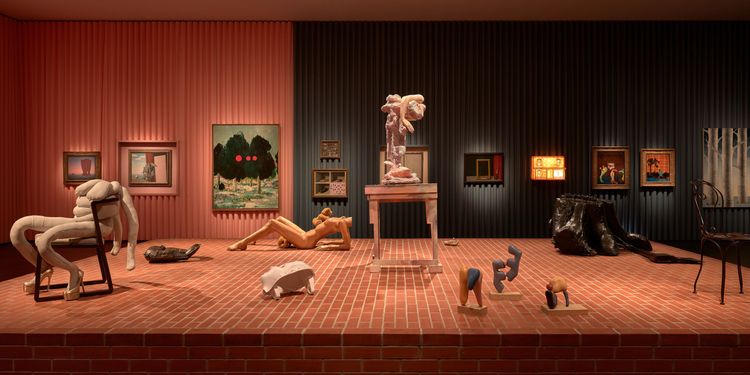
From the moment you enter, the exhibition draws you into Magritte’s Surrealist world; its playful design transforming the traditional white cube into a warm, draped interior. “We looked to the way Magritte hung his work, and he did love doing things that were slightly off-kilter, which feel like you’re walking into someone’s mind,” Lagrange tells me. “It wasn’t going to be a quiet show, we wanted as many things as possible to be in conversation with each other.”
Often by coincidence, pieces in This Is Still Not A Pipe: The Afterlife of Magritte connect with each other in surreal visual narratives that go beyond the intended curation, like Magritte’s La Sélection naturelle (1938), a painting of clouds dropping rain over fields, hangs directly below Victor Man’s Titiriteros (2023), Spanish for ‘puppeteers’. “It’s as if the puppeteers are looking down on the clouds with the power to raise them up if they wanted to,” says Bernard.
The curators worked with artist Alex Da Corte on the design; he also contributed Streetlamp For Drunk (2018), a towering, leaning lamppost glowing red in the entryway that sets the tone for what’s to come. With so many surreal and surprising pieces on show, quiet, neutral walls might have seemed the obvious choice, but Da Corte’s approach makes the gallery part of the exhibition, rather than simply its host.
The idea extends out onto the street, too, with homages to Magritte by theatre scene painters hung in the windows. “They are sort of Magritte’s missing pieces, rather than reproductions,” Bernard says. Take The Listening Room (1952), in which an apple fills a room – here, the homage removes the apple so only the interior remains. “Magritte was pretty creative with how he approached exhibitions, everything became part of an installation,” Lagrange says. Nearly six decades after his death, the same is true at the Gagosian.
This Is Still Not A Pipe: The Afterlife Of Magritte is on show at Grosvenor Hill gallery, London, until 12 December.









The Best Of Service95 ServedStraight To Your Inbox



What We’re Reading Now...
Service95 Book Club’s edit of the best books to add to your to-be-read pile
Find your next read