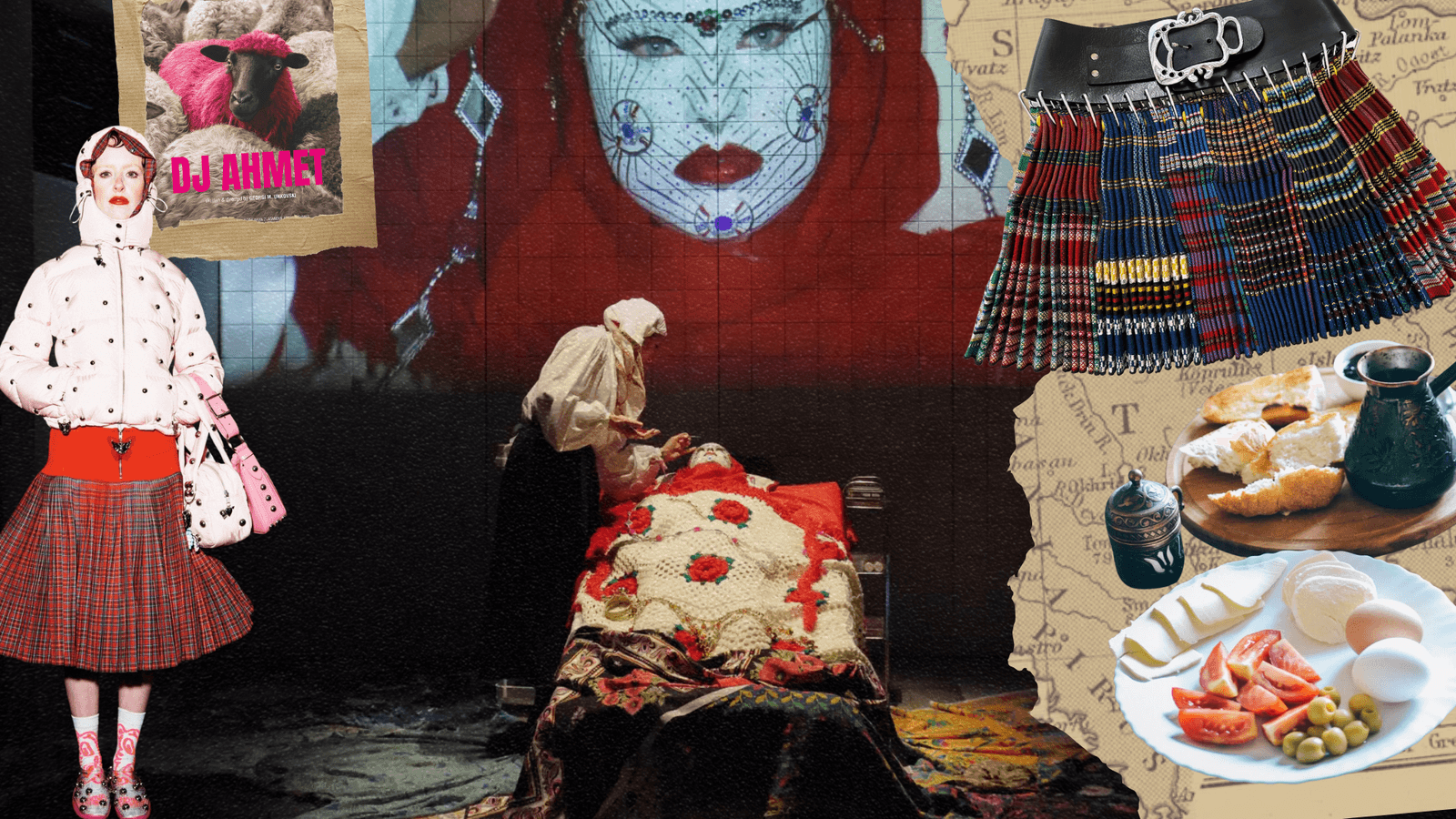
On a patch of artificial grass inside a gigantic warehouse, a group of women hoist up their pleated skirts and spread their legs to bare their vulvas, screaming to the Gods to stop the rain. Opposite, naked men hump the ground, moaning with each gyration. Elsewhere, a group of naked bodies lustily writhe with skeletons in a graveyard. I enter a trance state, taking it all in while leaning on a giant tumescent penis sculpture.
I’m in the audience for the latest work conceived by Marina Abramović, the legendary performance artist of rare-earth magnetism. Titled Balkan Erotic Epic, it had its world premiere at Manchester’s Factory International in the UK until this past weekend, before continuing on to Barcelona, Berlin, New York and Hong Kong. The performance sees 13 traditional rituals from the region of Southeastern Europe enacted simultaneously, with a focus on sensuality rather than sensationalism. “It’s my guts, my heart, my biography, everything I knew and learned about performance and history,” Marina, dressed in a long black shawl, says before the show begins. It’s deeply rooted in tradition. “I am Balkan, you see. We are crazy about love and passion and suffering and drama.”

Marina’s ecstatic rituals aren’t happening in a vacuum. After decades of being defined by conflict and cliché (for many, ‘Balkan’ was shorthand for chaos or kitsch), parts of the region are being reimagined from within: not as Europe’s unruly fringe, but as a source of radical beauty and emotional truth. Artists are reclaiming the drama, the ritual and the sensuality of their heritage, giving it a new and vibrant life.
An increasing number of creatives have been echoing Marina’s sentiment in recent years, reimagining rituals, motifs and recipes from trad Balkan culture. In fashion, designers like Kiko Kostadinov, Chopova Lowena and Roksanda Ilinčić have become household names (among those with enviable wardrobes) all recently paying homage to their homelands (see, for example, Lowena’s signature carabiner skirts crafted from upcycled Bulgarian aprons).
Earlier this year, British Vogue declared the ‘Balkan Breakfast’ (fresh vegetables, bread, cheese and meats) the new morning flex. Balkan cinema has also enjoyed a bumper year across the globe, with acclaimed releases such as Sundance award-winner DJ Ahmet drawing on the region’s rich history. “We’re living in a world where if you have something to say, it’s important to say it now,” Romanian director Mihai Mincan told Variety.

Researcher and curator Arbër Qerka-Gashi, whose work focuses on Balkan culture, has clocked this trend. “I have noticed it for sure. As someone deeply invested in the area, I’ll notice a stitch pattern or melody or type of cuisine [spreading],” he says. “There’s almost been a Balkan Renaissance happening in the UK. I think it’s great that our diaspora is becoming more well known for the richness of its cultural production.” Arbër’s own project, Balkan London Collective, co-founded with Tamara Vujinović, embodies this spirit with its queer club nights at Dalston’s Ridley Road Market. It brings the community together in a safe and joyous space that counteracts past negative clichés surrounding the region (soundtracked by Balkan-influenced DJs and catered for, no less, by his Mum). “It’s been monumental,” he says. “We’ve had people show up to the events and literally cry,” he says, explaining that it’s often a cathartic experience.
But why are others, outside the diaspora, suddenly interested in trad Balkan culture? It’s actually something that’s been building quietly over the past decade, powered by a second generation of diaspora creatives reconnecting with their parents’ cultures, through cheap flights and open borders (countries closed to tourists until the ’90s, such as Albania and Bulgaria, are more popular than ever) that have made the region newly accessible. And, of course, there’s Gen Z’s endless appetite for authenticity. Global subcultures – from ‘folk revival’ fashion to post-pandemic spirituality – have primed audiences for rituals, symbols and stories that feel rooted and real.
“One impulse is the endless thirst in our current culture for fantasy and escapism,” says Vid Simoniti, a senior lecturer at the University of Liverpool, who contributed an essay for the programme of Balkan Erotic Epic. The end of his text captures this desire to transcend the confines of reality. “The Balkan spirit teaches another, more surprising lesson: the lesson that’s a bit like the peasant man having sex with the earth when the crops fail. Sometimes the best response to a hopeless situation is to go totally over the top. To go beyond reason: into myth.” Perhaps, in our era of permacrisis, summoning ancient rites is the only way to endure.
“There’s almost been a Balkan Renaissance happening in the UK. I think it’s great that our diaspora is becoming more well known for the richness of its cultural production”
Arbër Qerka-Gashi
For many within the community, the newfound fascination with Balkan tradition feels long overdue – a recognition of something they’ve always known. “I think the Balkans prides itself on hospitality... it’s a beautiful trait we have,” Arbër says. “People are realising we have our own culture,” adds Spasia Dinkovski, who runs outrageously-good Balkan bakery Mystic Burek (soon to reopen as DOMA in Sydenham, London). She notes that some people in the past have tried to shoehorn the Balkans into the rest of Europe. “It’s beautiful that so many others are starting to see how we are our own entity and how we are so steeped in tradition, it’s about time that we have our moment.”
But appreciation, rather than appropriation, is always vital. “[Most Balkan people] are willing to open their culture to people from outside the region, but it’s just a matter of respect, of engaging in conversation and reading about it,” says Arbër. The region’s history, after all, is exceptionally complex and inextricably bound to internal conflict, the rise and fall of Yugoslavia and dictator Tito (whose shadowy figure looms large throughout Balkan Erotic Epic).
Dismissing this can also lead to an exoticisation of the region – something Arbër explores this through his archival project Balkanism, named after historian Maria Todorova’s term, which applies the theory of ‘Orientalism’ to a damaging othering of Balkan culture. “If you’re using this face painting ritual, or you’re using this kind of cultural garb, but you’re not understanding the full implications... it’s exploitative,” he says.

On other occasions, this leads to a damaging simplification. “There is a hunger to always dumb [down] culture; make it fit capitalistic views – [which is] not very Balkan at all,” says Spasia. “Everything must please the masses, be watered down and homogenised, so there is a danger that we will always just scratch the surface of all of the beauties that come from our part of the world,” she says.
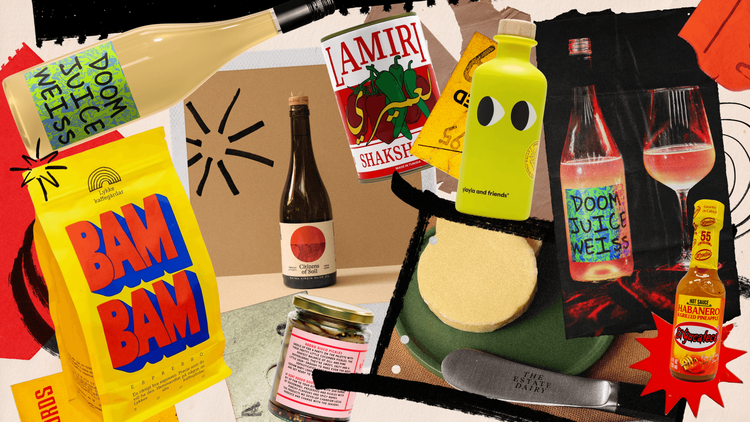
She points to the recent popularity of ajvar, a traditional and seasonal ‘slow food’ painstakingly handmade over days by families: “Why am I now seeing this word in supermarkets, reducing it to just a ‘red pepper spread’ all year round? Context and education is more than welcome and some parts of our lives, as a people, should just be left to us.” And within the diaspora itself, of course, there are intricacies to address. Arbër, for example, started his own projects to rally against existing Balkan platforms and spaces that sometimes espoused conservative, ethnonationalist and homophobic views. “It was a reclamation of my identity from a diaspora perspective.” Representing the region’s myriad nations and their distinctive traditions is no easy feat.
As Marina Abramović is, likely, all too aware. Back at Factory International, after a powerhouse display of stamina from the many consummate performers (one woman has had milk poured on her in a shower for four hours), Marina appears. She is, no surprise, the last one standing, passionately slow dancing and locking lips with first-time collaborator Blenard Azizaj in a taverna setting. It’s a tender climax to Balkan Erotic Epic, a powerful symbol for trad culture’s embrace of the old and the new. As I leave, the daze slowly fading, a few words from her speech earlier echo in my mind: “I did not invent these rituals. Everything is based on real truths.”